

Organizations create and store massive amounts of information every single day. This includes customer records, financial transactions, intellectual property, and operational data.
As data keeps growing, complexity grows with it. To manage it well, organizations rely on data classification. This process organizes data based on sensitivity, business value, and compliance requirements.
Data classification helps teams make smarter decisions about protection and access. They encrypt highly sensitive data. They allow less critical information to move more freely. This targeted approach strengthens overall security and avoids wasting resources on low risk data.
Classification also plays a key role in regulatory compliance. It gives organizations the visibility and structure they need to meet standards such as GDPR, HIPAA, and PCI DSS.
When teams clearly understand what data they hold and how sensitive it is, they handle it more responsibly and respond to audits with confidence.
Data classification is not just a technical exercise. It drives governance, supports risk management, and improves operational efficiency. Most importantly, it helps organizations unlock real value from their most important data assets while keeping them protected.
Core Concepts & Frameworks
Before applying best practices, organizations need to understand the core ideas behind data classification. They must know what it means and why it matters.
At its core, data classification organizes information based on sensitivity, business value, and compliance needs. Teams group data into clear categories so they can manage it properly.
This approach ensures data gets the right level of protection based on its risk and importance. Organizations stop treating all data the same. Instead, they focus stronger controls on high risk information and apply lighter controls where appropriate.
Data Classification Frameworks
A data classification framework sets the structure for how an organization groups and protects its data. It defines clear categories and links each category to specific controls.
Most frameworks include clear classification levels such as Public, Internal, Confidential, and Restricted or Highly Confidential. Each level reflects a different degree of sensitivity.
They also provide simple definitions and real examples for every level. This helps teams apply the labels consistently across the organization.
The framework outlines handling rules as well. It explains how teams should store, access, encrypt, share, and destroy data at each level.
When organizations use a formal framework, they make classification decisions in a consistent and practical way. They align data protection with business priorities and regulatory requirements.
Key Classification Levels
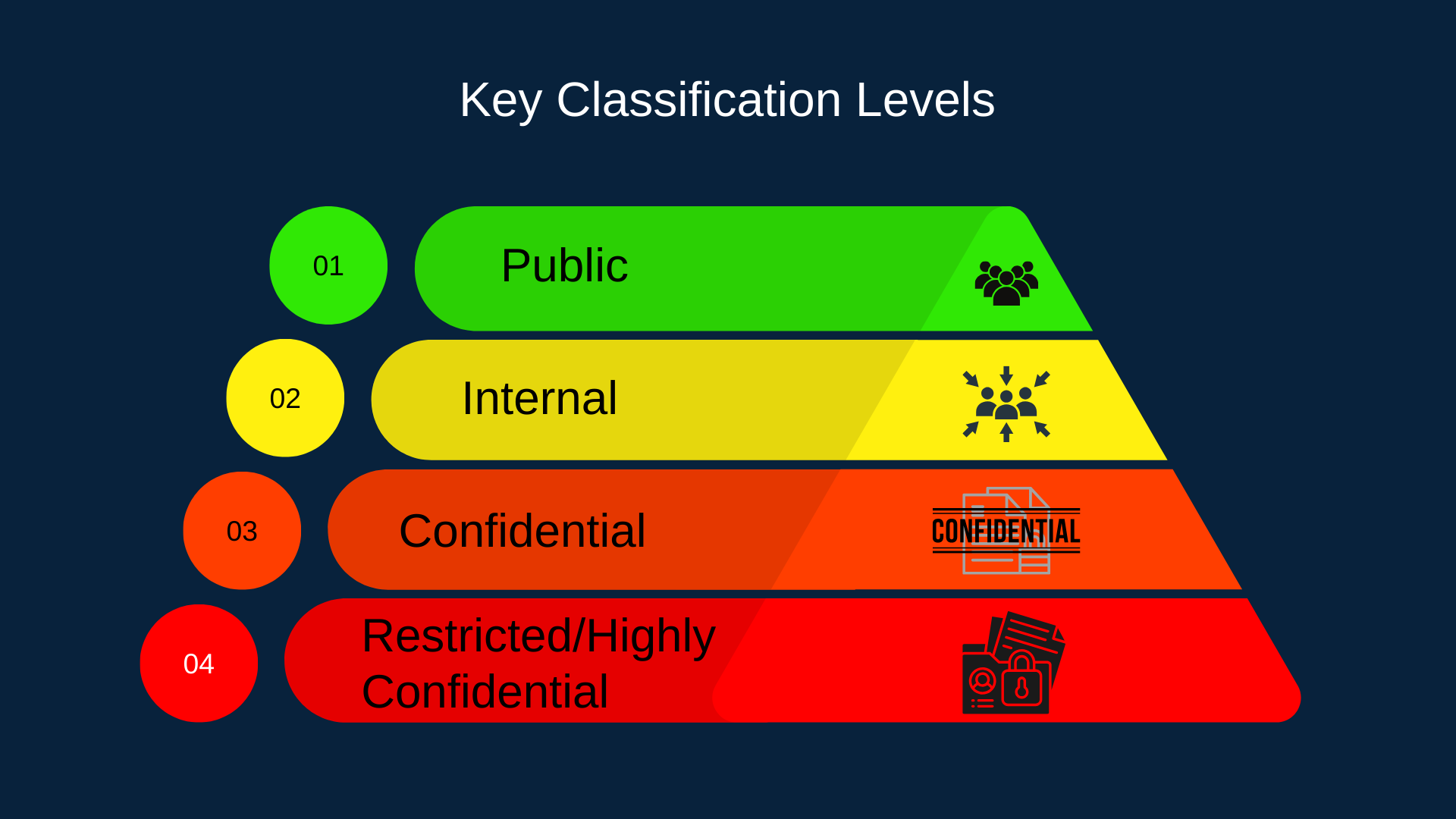
Most data classification frameworks follow a tiered approach. They divide data into levels based on how sensitive it is.
- Public or Public Use data is meant for open distribution. It carries little to no risk if others access it.
- Internal Use data stays within the organization. Teams use it for daily work, but they do not share it outside.
- Confidential data includes sensitive business or personal information. If someone exposes it, it can cause financial, legal, or reputational damage.
- Restricted or Highly Confidential data sits at the highest level. This includes intellectual property, PHI, and regulated customer data. Organizations protect this data very strictly.
Each level defines the security controls required. As sensitivity increases, protections increase too. Teams apply stronger encryption, tighter access controls, and more active monitoring for higher risk data.
Classification Approaches
Organizations use different methods to label data based on content, context, or user input.
- Content based classification scans the actual data. It looks for sensitive elements such as credit card numbers, PII, or health records. Many teams automate this process so they can handle large volumes of data quickly.
- Context based classification looks at metadata instead of the content itself. It checks where the data lives, who owns it, how people access it, and which system created it. This extra context helps teams judge sensitivity more accurately.
- User based classification relies on data owners. They tag and label information using their own knowledge of the business. This works well for complex or nuanced cases, but teams must enforce clear rules to keep labels consistent.
Most modern programs combine all three methods. They use automation to scale and save time. At the same time, they rely on human judgment to improve accuracy and reduce mistakes.
Foundational Best Practices
Organizations need a structured plan to build a strong data classification strategy. They must align it with business goals, regulatory requirements, and security priorities. When they take a clear and practical approach, they create a program that lasts.
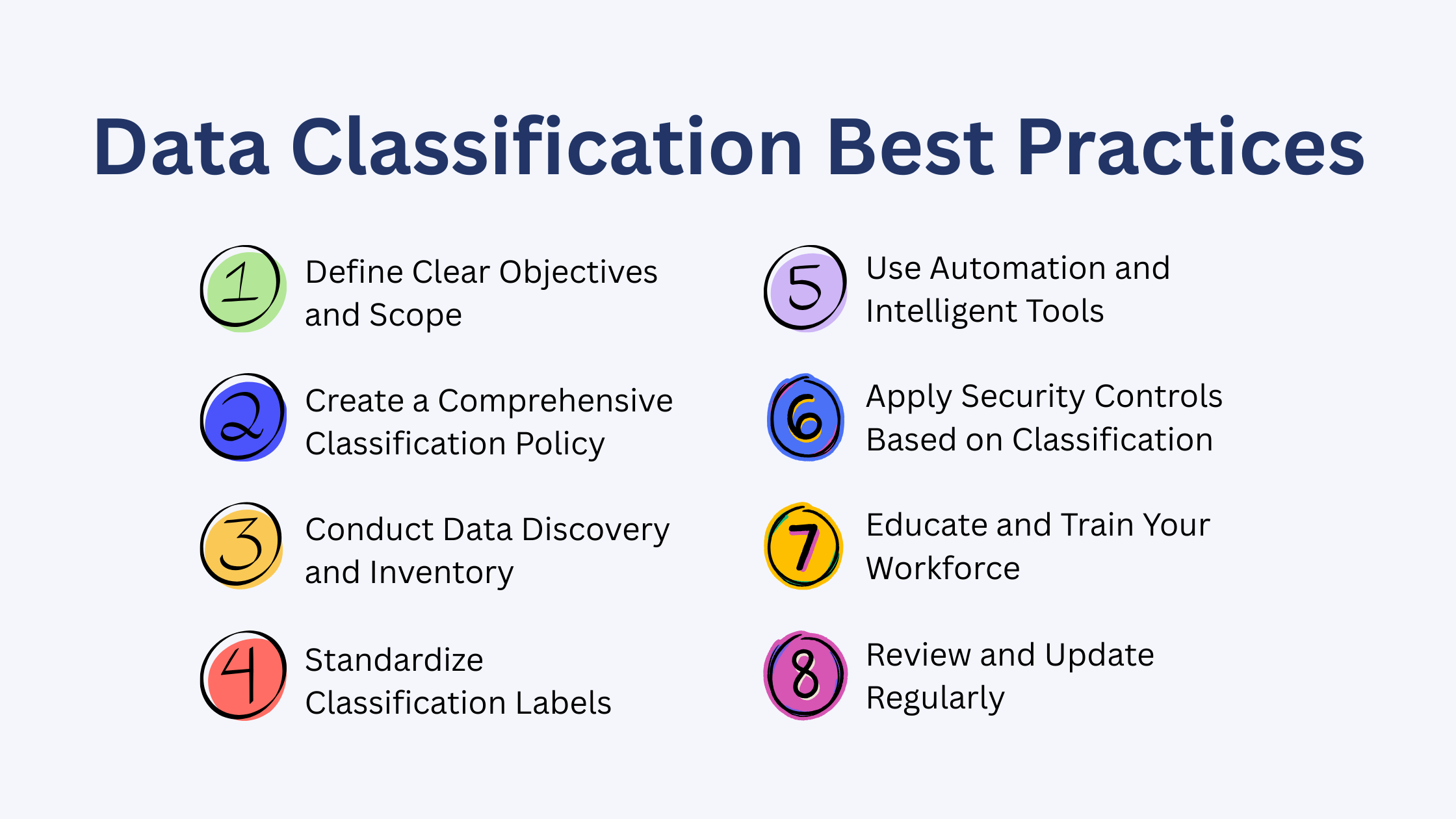
1. Define Clear Objectives and Scope
Start by defining why the program exists. Decide if the main goal is security, compliance, governance, analytics, or a mix of these. Clear goals keep teams focused. They also make it easier to measure success and gain executive support.
2. Create a Comprehensive Classification Policy
Develop a formal policy that explains classification levels and the criteria for assigning them. Define roles and responsibilities clearly. Show how classification connects with security and compliance processes. This keeps everyone aligned, both technical and business teams.
3. Conduct Data Discovery and Inventory
Identify where data lives. Look across structured and unstructured data, on premises systems, devices, and cloud platforms. Build a complete inventory. When teams know what they have, they reduce blind spots and classify data more accurately.
4. Standardize Classification Labels
Use consistent labels such as Public, Internal, Confidential, and Highly Restricted. Align these labels with your risk tolerance and regulatory needs. Consistency helps employees understand and apply them correctly.
5. Use Automation and Intelligent Tools
Adopt AI driven or rule based tools to scan and tag data. Automation saves time and improves accuracy. It also helps teams manage large volumes of unstructured data without slowing down.
6. Apply Security Controls Based on Classification
Match protection levels to data sensitivity. Encrypt sensitive information. Limit access through role based controls. Monitor usage regularly. Strong alignment between classification and controls makes protection practical and enforceable.
7. Educate and Train Your Workforce
Train employees on the policy and their responsibilities. Show them how to classify data correctly and handle it with care. When people understand the process, they make fewer mistakes and support a culture of accountability.
8. Review and Update Regularly
Schedule regular audits and reviews. Update classifications as data grows, systems change, or new regulations appear. Continuous improvement keeps the program relevant and effective over time.
Automation & Tooling
Modern data environments grow fast. Data spreads across cloud platforms, on premises systems, and SaaS apps. Volumes increase every day. Formats keep changing. In this kind of environment, teams cannot rely on manual work. They need automation to classify data effectively.
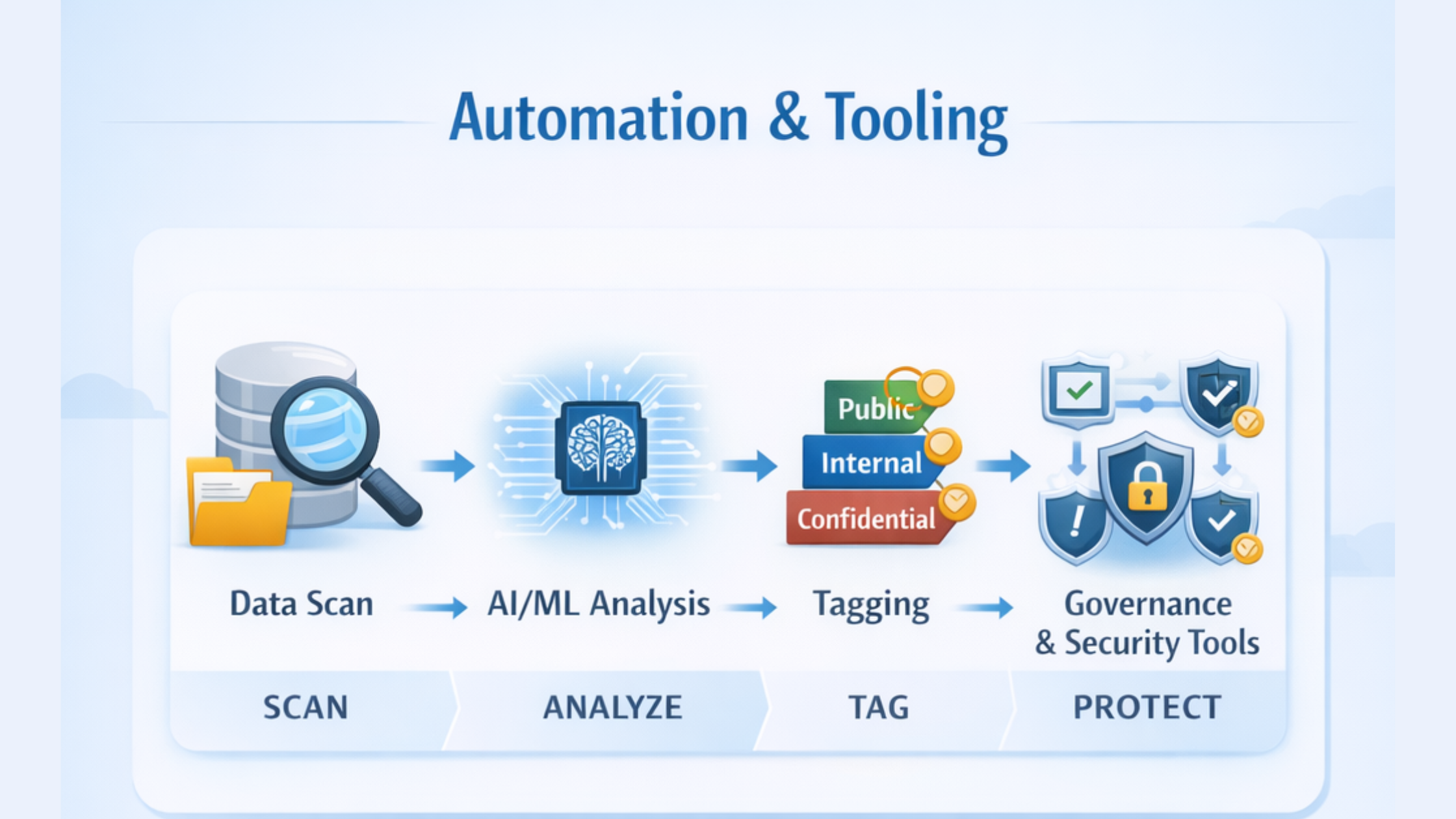
Automated tools classify data at scale. They keep labels consistent, reduce manual effort, and connect classification with broader governance and security processes.
Why Automation Matters
Manual classification takes time. People make mistakes. Teams cannot keep up with the speed of data growth. Automation solves this problem.
It scans and classifies large datasets across structured and unstructured sources without slowing down. Reduces human error and limits inconsistent tagging. It uses rules, metadata, and machine learning to understand both data content and how people use it. This improves accuracy.
Automation also adapts as data changes. When content or policies evolve, the system can reclassify data. This keeps labels accurate over time.
Core Automation Capabilities
- Continuous scanning and classification: Tools monitor data at rest and in motion. They tag new or modified data in real time.
- Rule based and AI driven detection: Systems combine keyword matching with machine learning, natural language processing, and contextual analysis. This works especially well for unstructured data.
- Metadata enrichment: Tools extract and enhance metadata such as file location, owner, file type, and timestamps. Rich metadata improves both classification and governance.
- Integration with security and governance systems: Classification labels connect directly with IAM, DLP, and encryption tools. This makes protection automatic and immediate.
Examples in Practice
Snowflake automatically scans tables, applies classification profiles, and tags sensitive data. Teams use these tags to support governance and compliance workflows.
Spirion focuses on persistent tagging and rule based classification. Its labels travel with the data across environments, which helps maintain accuracy.
Advanced platforms combine metadata enrichment, AI detection, and tag synchronization. Labels flow between data catalogs, governance layers, and enforcement systems. This creates a connected and responsive ecosystem.
Choosing the Right Tools
When selecting automation data classification tools, teams should look for solutions that support real time classification and reclassification. The tools should handle both structured and unstructured data across multiple environments.
They must integrate with existing governance and security systems so labels trigger real action. Strong machine learning and metadata enrichment features also help reduce false positives and improve accuracy.
Security Controls & Enforcement
After teams classify data, they must enforce the right security controls. Classification alone does not stop breaches. Strong and aligned controls reduce risk and protect sensitive information across its entire lifecycle.
Apply Controls Based on Sensitivity
Security teams should match controls to classification levels. Confidential or restricted data needs strong protection. Public data needs far less. When teams align controls with sensitivity, they focus time and resources where risk is highest.
1. Role Based Access Control and Least Privilege
Teams use role based access control to assign permissions based on job roles. They avoid giving broad access to everyone. Each user gets access only to the data required for their job. When teams apply the principle of least privilege, they reduce exposure and limit misuse.
2. Encryption at Rest and in Transit
Encryption protects data in every state.
- At rest, teams protect databases, files, and backups.
- In transit, they secure data moving across networks using TLS or VPN connections.
Strong encryption standards and proper key management make this protection reliable. Without good key control, encryption loses its value.
3. Data Loss Prevention and Monitoring
DLP tools monitor how people move sensitive data. They detect risky actions such as sending confidential files by email or uploading them to cloud apps. Teams also log and audit data access continuously. They track who accessed what, when, and under which conditions. This visibility helps them detect policy violations quickly.
4. Multi Factor Authentication and Contextual Controls
Teams add multi factor authentication to strengthen login security. Users must verify their identity with more than just a password.
They also apply contextual controls. The system checks device health, location, and access time. It adjusts permissions in real time. This makes security more dynamic and harder to bypass.
5. Enforcement Across the Data Lifecycle
Teams protect data from creation to deletion.
They define retention and deletion policies to limit how long they store information. They securely dispose of data through certified destruction or secure wiping. These steps prevent leftover data from leaking later.
Lifecycle controls keep protection consistent at every stage.
6. Administrative and Organizational Controls
Technical controls alone are not enough. Organizations must document procedures and define clear handling processes. They prepare incident response plans in advance. They train employees regularly and raise awareness about proper data handling. When people understand their role, they make fewer mistakes and support stronger security overall.
Compliance & Governance
Data classification does more than organize information internally. It helps organizations meet legal and regulatory requirements. It also supports scalable and structured data governance. When teams classify data properly, they gain visibility. They manage information responsibly. They reduce risk across complex digital environments.
Classification as a Compliance Foundation
Global regulations such as GDPR, HIPAA, CCPA, PCI DSS, and ISO/IEC 27001 require organizations to identify and protect sensitive information in clear and auditable ways. Classification makes this possible.
With proper classification, teams can locate personal or regulated data quickly. They apply the right protections based on sensitivity. They also provide clear evidence during audits.
Without classification, organizations struggle to track PII, PHI, or payment card data. Audits take longer. Costs increase. Risks grow. Classification simplifies audits by helping teams find data fast, verify controls, and confirm compliance with confidence.
Integrating Classification into Governance
Data governance ensures data is accurate, secure, and used responsibly. Classification is a critical pillar of governance, providing context for policy enforcement and risk management. Key elements include:
- Roles and ownership: Assign responsibility for classifying, approving, and monitoring data.
- Policies and standards: Define how data is classified, handled, protected, and audited.
- Lifecycle management: Set retention, archiving, and disposal rules based on classification.
- Audit and review cycles: Regularly validate that classification rules remain current and compliant.
Embedding classification in governance ensures consistent, auditable handling of data aligned with business and legal requirements.
Governance Benefits Beyond Compliance
Classification improves more than compliance. It improves data quality and reliability, helps teams manage storage better and reduce unnecessary costs, and gives employees faster access to trusted data, which supports better decisions. Also, it builds accountability and strengthens data stewardship across the organization.
Staying Ahead of Regulatory Change
Regulations continue to evolve. Business needs change as well. Strong programs adapt quickly.
Organizations run regular audits and review classification rules. They train stakeholders and keep awareness high. They use automation tools to adjust classifications as data grows or regulations shift.
When teams take a proactive approach, they turn compliance into a strategic advantage. They reduce risk, build trust, and strengthen governance across the entire organization.
Organizational Best Practices
Effective data classification takes more than tools and written policies. It needs structure. It needs ownership. Most of all, it needs people who take responsibility. Organizations must weave classification into daily operations, not treat it as a side task. These best practices help build a program that lasts.
1. Assign Clear Roles and Responsibilities
Define roles such as data owners, custodians, and stewards. Clarify what each role must do across the data lifecycle. When people know their responsibilities, they classify and protect data more consistently. Clear ownership prevents confusion and gaps.
2. Foster Cross Functional Engagement
Bring security, compliance, legal, IT, and business teams together. Let them shape policies from the start. Early collaboration aligns classification with real business needs. It also breaks down silos that often slow progress.
3. Promote Training and Awareness
Train employees regularly on classification rules and labeling practices. Explain the risks of misclassification in simple terms. When staff understand why it matters, they take it more seriously. Ongoing education reduces mistakes and closes security gaps.
4. Establish a Culture of Accountability
Encourage employees to see data as a valuable asset. Help them understand the risks tied to misuse or exposure. Make classification part of their daily responsibilities. Recognize teams that follow best practices. A strong culture makes classification everyone’s priority, not just IT’s job.
5. Integrate Classification with Governance
Connect classification with broader governance efforts such as data quality, retention policies, and incident response planning. This integration creates consistency. It strengthens oversight and improves control over critical data.
6. Review and Update Regularly
Audit classifications on a regular basis. Update policies when data types, systems, or regulations change. Refine processes when something does not work well. Frequent reviews keep the framework aligned with real risks and business priorities.
7. Encourage Feedback and Continuous Improvement
Create simple channels for feedback. Let employees report issues or suggest improvements. Listen to their input. Continuous feedback helps the program adapt to new data types, emerging threats, and changing compliance demands. Over time, small improvements make a big difference.
Common Challenges and How to Overcome Them
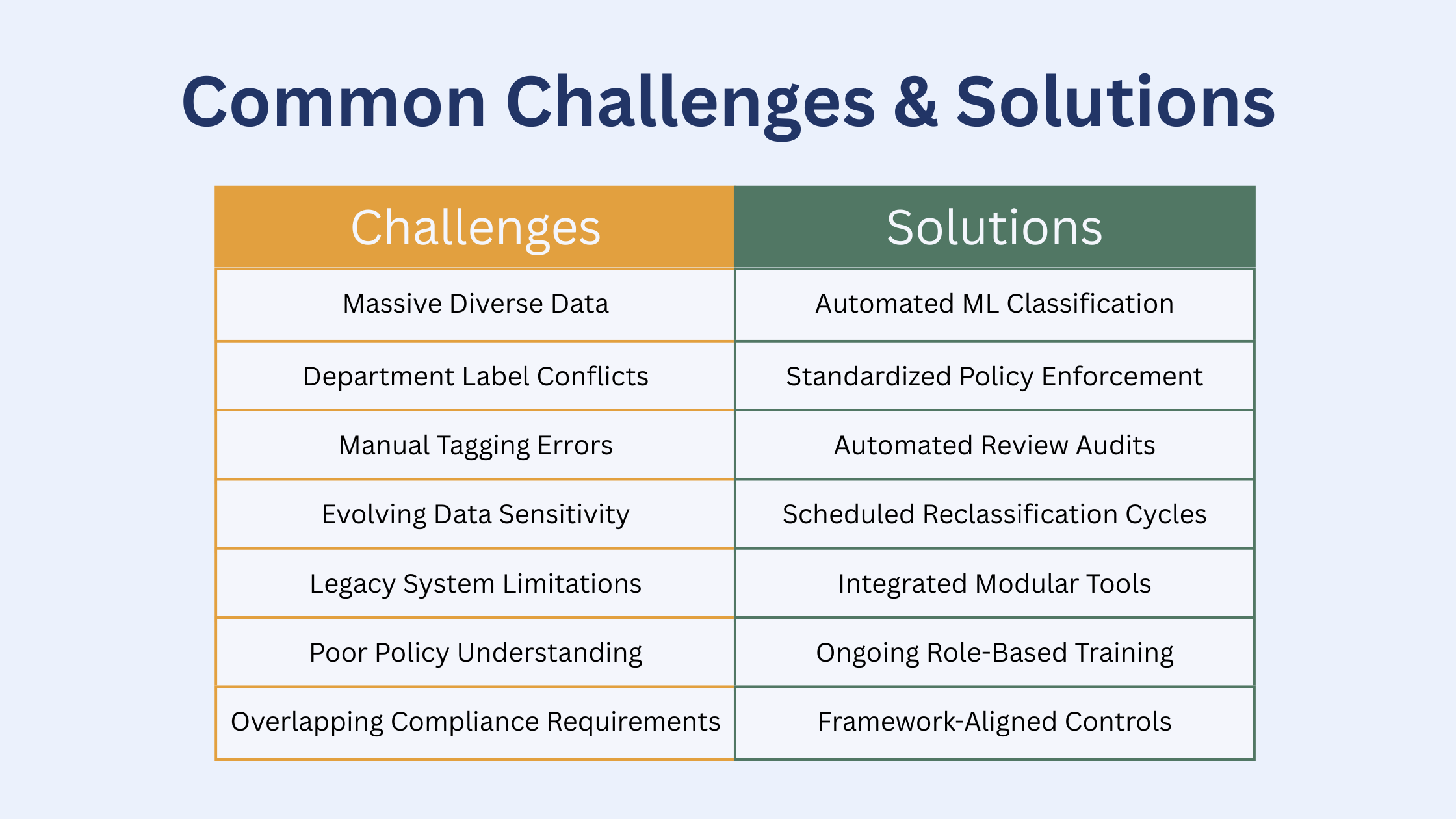
Implementing a data classification program boosts security, governance, and compliance, but it comes with challenges. Organizations face technical and organizational obstacles that can weaken classification efforts if ignored. The right strategies can turn these challenges into manageable tasks.
1. Scaling Across Large and Diverse Data Sets
Challenge: Companies manage massive data across structured databases, unstructured files, cloud systems, and endpoints. Manual classification is slow and often incomplete.
Solution: Use automated tools with machine learning and rule-based engines. Combine automation with human review for high-risk data. Perform regular data discovery to catch hidden or “shadow” data.
2. Inconsistent Classification Across Departments
Challenge: Teams may label the same data differently, causing protection gaps and compliance risks.
Solution: Create a standardized classification policy with clear definitions and examples. Train employees and embed automated enforcement to ensure consistent labeling.
3. Manual Processes and Human Error
Challenge: Manual tagging is slow and prone to mistakes, even with trained staff.
Solution: Automate discovery and classification. Have data stewards check complex cases. Run regular automated audits to catch errors early.
4. Keeping Classification Updated Over Time
Challenge: Data sensitivity and regulations change. Old classifications can weaken security and compliance.
Solution: Set regular review cycles. Use automated reclassification based on metadata and usage patterns to keep labels current.
5. Technology Limitations and Integration Issues
Challenge: Legacy systems and disparate platforms make consistent classification hard, especially for unstructured or unusual data.
Solution: Choose tools with strong integration support, APIs, and connectors. Build a modular system where classification metadata flows across platforms and triggers controls like DLP and access management.
6. Lack of Awareness and Training
Challenge: Employees may not understand policies, leading to mislabeling or mishandling.
Solution: Provide ongoing, role-specific training with examples and workshops. Teach why classification matters and how to apply it correctly.
7. Regulatory Complexity
Challenge: Organizations must comply with overlapping frameworks like GDPR, HIPAA, and CCPA, each with different requirements.
Solution: Align classification policies with compliance frameworks. Build flexible controls. Involve legal and compliance teams. Document decisions for audits and ongoing accountability.
Case Studies / Real‑World Examples
Real-world examples show how data classification improves security, compliance, and operational efficiency across industries.
1. Day Pitney — Strengthening Legal Data Security
A U.S. law firm rolled out enterprise-wide classification to gain control over sensitive client and proprietary data. They:
- Located and labeled sensitive data like PHI and payment card information.
- Monitored user access and received alerts for changes to privileged accounts.
- Detected risky account setups, such as unexpired passwords or inactive accounts.
These actions boosted security, improved compliance, and increased accountability for legal records.
2. Global Financial Firm — Enhancing Operational Security
A multinational bank applied classification to manage large volumes of customer and transactional data. They achieved:
- Faster data retrieval and improved operational efficiency.
- Clear identification and protection of sensitive financial data for better regulatory compliance.
- Stronger defenses against unauthorized access and potential data leaks.
Classification allowed risk-based controls, which are crucial in regulated financial environments.
3. Healthcare Provider — Protecting Patient Records
A regional healthcare network used automated classification to secure patient data and improve HIPAA compliance. Results included:
- Automatic identification of PHI across structured and unstructured data.
- Consistent labeling to enforce encryption and access restrictions.
- Lower compliance risk and improved data integrity, enabling quick access to critical information.
Classification supported regulatory compliance and operational performance where speed and accuracy matter.
4. Enterprise-Wide Adoption — Making Classification a Habit
A multinational enterprise with 12,000 employees across 130 locations implemented standardized classification guidelines. Outcomes included:
- Recognition of data as a strategic business asset.
- Executive sponsorship embedding classification into daily workflows.
- Employees gained confidence enforcing policies, strengthening governance.
This example shows how classification can grow from a technical initiative into a cultural practice that improves security and collaboration.
Conclusion
Data classification is a cornerstone of security, governance, and compliance. Just labeling data is not enough. Organizations need to embed classification into security controls, governance frameworks, and daily operations.
Effective classification helps organizations:
- Protect information based on sensitivity, business value, and regulatory needs.
- Streamline compliance with privacy laws like GDPR, HIPAA, and CCPA.
- Reduce risk by focusing resources on high-value data.
By combining clear classification rules with automation and governance, organizations gain visibility into their data, improve efficiency, provide faster access for authorized users, cut storage costs, and make better decisions.
Implementing classification can be tough. Challenges include scaling across diverse data types and getting consistent adoption. But the long-term benefits far outweigh the effort. Classification is not just a technical task. It is a strategic tool that strengthens security, boosts compliance, builds accountability, and turns data into a trusted organizational asset.